Annaprashan Sanskar: Every family has a moment they never forget. The moment a baby tastes solid food for the very first time. In most homes today, this decision is driven by the paediatrician’s advice, the family’s preference, or simply when the baby seems ready. But in our tradition, this moment has always been so much more than a feeding milestone. It is a sanskar, one of the sixteen sacred rites of passage in Hindu tradition, and it comes with its own set of rules, its own muhurat, and its own shastric wisdom that our ancestors carefully preserved for us.
Annaprashan, is the ceremony where a child is formally introduced to solid food for the first time. The word itself means “entry of food” in Sanskrit. What makes it meaningful is not just the act of feeding but the intention behind it, the timing of it, and the way it is done.
Read more about baby’s first solid food
What Age Should Annaprashan Be Performed?
According to the Grihyasutras, Annaprashan should ideally be Annaprashan Sanskar performed in the sixth month after birth. This aligns closely with what modern paediatric science also recommends, that a baby’s digestive system is developed enough to process solid food from around six months of age.
Read more about Annaprashan Sanskar
The timing is not arbitrary. The sixth month marks a significant shift in both the baby’s physical development and nutritional needs. Breast milk alone is no longer sufficient. Our shastras recognised this transition and marked it with a ceremony so that it would never be rushed or ignored.
Which Food Is Given First and Why
The first food given during Annaprashan is not random. Shastra specifies rice as the primary food for this ceremony, and there are clear reasons for this.
- Rice is the lightest and most easily digestible grain available. It is gentle on an infant’s developing gut and unlikely to cause allergic reactions.
- The rice is typically cooked as a soft kheer or thin rice preparation, sweetened with jaggery or honey and mixed with ghee.
- Ghee is considered a brain tonic in Ayurveda and is specifically prescribed for the healthy development of a child’s nervous system and intellect.
- Jaggery provides natural iron and energy. Honey, in small amounts, is considered a carrier of strength and vitality in Ayurvedic tradition.
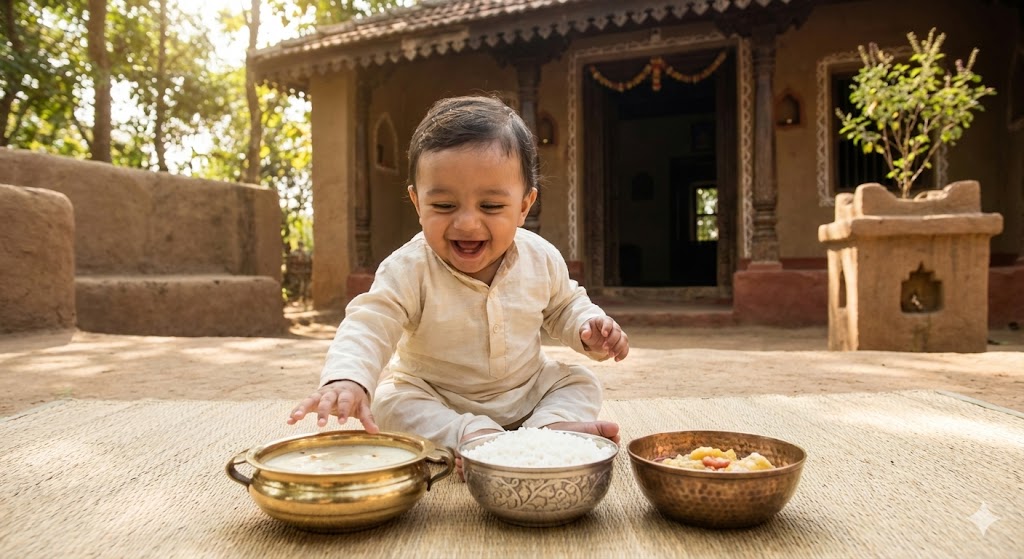
In many communities, the ceremony also includes a beautiful tradition where the baby is presented with a small array of foods representing the six tastes recognised in Ayurveda for Annaprashan Sanskar, sweet, salty, sour, bitter, pungent, and astringent. Each taste corresponds to a different quality of life and nourishment. The idea is that the child’s first encounter with food is not just one flavour but a complete experience, a symbolic introduction to the fullness of life itself. The baby’s natural response to each taste is observed by the family, often with great warmth and laughter, making it one of the most memorable moments of the ceremony.
According to Ayurvedic principles, food is not just nutrition but an energetic input that shapes a child’s constitution and health over a lifetime. This is why the first food must be pure, natural, and given with intention rather than convenience.
Read more about Birth Sanskars
The Significance of the Vessel Used
Something many families overlook is the material of thevessel in which the first food is offered. According to Ayurveda, the metal of the vessel affects the properties of the food it holds. This is not superstition but an understanding of how different metals interact with food.
Silver is considered cooling, antibacterial, and calming to the body. Gold is strengthening and builds ojas, the body’s vital life force. Bronze, known as kansa, Annaprashan Sanskar supports digestion and is considered the most balanced option for feeding children. Many families choose silver bowls and spoons for Annaprashan, and the practice is backed both by tradition and Ayurvedic reasoning.
Read more about the right vessel
Common Mistakes Families Make
The most common mistake is treating Annaprashan as a party rather than a sanskar. When the ceremony is Annaprashan Sanskar reduced to a photo opportunity and the actual vidhi is rushed or skipped, the child misses the shastric benefit the ceremony is intended to provide.
Another mistake is choosing the wrong muhurat or no muhurat at all. An inauspicious day that conflicts with the child’s own Janm Kundali is entirely avoidable with proper consultation.
Using processed or packaged food for the first feeding is also against the spirit of the ceremony. The first food must be freshly prepared, natural, and offered with care.
How Vandan Pandit Helps
Annaprashan is a ceremony that deserves to be done correctly, with the right muhurat, the right mantras. At Vandan Pandit, we handle the complete Annaprashan Sanskar at your home, including muhurat selection, and the full ceremony Annaprashan Sanskar with all required samagri provided by us. Along with that, an interactive guidance video is also provided to help you conduct the whole ceremony step-by-step on your won with complete ease.
If you’re searching for “baby’s first food ceremony near me,” “Annaprashan Puja in Mumbai,” “Annaprashan ceremony”, “Annaprashan vidhi”, “Annaprashan ceremony at home Mumbai” then Vandan Pandit is your most reliable choice.
With our Annaprashan ritual kits, you can now perform the ceremony from the comfort of your own home with complete peace of mind. Our carefully prepared kits ensure that every mantra, Annaprashan Sanskar offering, and step of the ritual follows Annaprashan Sanskar Vedic tradition, so you can focus fully on devotion and your child’s sacred beginning.
With clear guidance and authentic samagri, families can Annaprashan Sanskar perform the baby’s first food ritual on their own, knowing it is done with purity, care, and spiritual correctness.
Why families trust our Annaprashan kits
- Essential mantras included with clear guidance for correct chanting
- Complete, pre-arranged samagri prepared as per Shastra
- Simple, step-by-step flow that allows you to perform the ritual at home
- Support available to help you select the right kit and perform the ritual correctly
📞 Book your Annaprashan Puja in Mumbai today – 8104030300
🌐 Vandan Pandit – Trusted Panditji Services for Every Sacred Beginning