Seemantonayan vs Baby Shower: 5 Differences Every Parent Should Know
When a young couple announces they are expecting, well-meaning friends often suggest a baby shower. And equally, grandparents mention something called Seemantonayan or Godh Bharai. For many modern families, these terms seem to refer to the same thing, a celebration of the pregnancy before the baby arrives.
They are not the same thing. Not even close.
Understanding the difference between seemantonayan vs baby shower and between godh bharai and seemantonayan reveals something profound about what the Vedic tradition understood about pregnancy, and what modern celebrations, however joyful, are missing.
Read More about Important of Seemantonayan Garbh Sanskar
What Is a Baby Shower?
A baby shower is a Western social tradition that emerged in the mid-20th century. Its purpose is celebratory and practical: friends and family gather to celebrate the expectant mother, give gifts for the new baby, and mark the approaching birth with joy and community.
There is nothing wrong with a baby shower. It is an expression of love and anticipation. But it is a social event. It has no ritual structure, no mantra, no divine invocation, and no intention beyond celebration and gifting.
What Is Seemantonayan Sanskar?
Seemantonayan is the third of the three prenatal Garbh Sanskars prescribed in the Vedic tradition. It is performed in the sixth or seventh month of pregnancy and is among the oldest documented prenatal ceremonies in human history, described in the Grihyasutras, the Garbhopanishad, and the Paraskara Grihyasutra.
The name itself encodes its purpose. Seemant means the parting of hair, specifically the hairline at the crown of the head, which is associated in Vedic anatomy with the Brahmarandhra, the subtle energy centre at the top of the skull. Utnayan means to elevate or to draw upward. The full meaning is: the elevation of energy through the crown, specifically, the elevation of the baby’s developing consciousness. It is blessings for your baby and also for you to have a safe and sound delivery.
This is not metaphor. The ceremony’s central ritual, in which the husband parts his wife’s hair from the forehead upward, is understood in the tradition as a deliberate act of directing prana, or life force, upward toward the developing brain of the fetus.
Read more about relevance of Seemantonayan Garbh Sanskar
7 Profound Differences Between Seemantonayan and a Baby Shower
1. One Is a Ritual. The Other Is a Ceremony.
The most fundamental difference between seemantonayan vs baby shower is the presence or absence of spiritual intention and ritual structure.
A baby shower has no prescribed form. There may be games, there may be gifts, there may be cake. These are lovely, but they have no shastraic basis and no divine invocation.
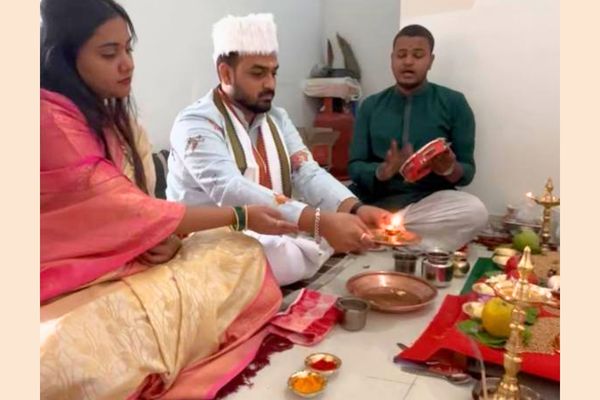
Seemantonayan follows a precisely prescribed vidhi, a ritual sequence that includes Ganapathi Puja, mantra recitation, havan, the hair-parting ceremony performed by the husband, and offerings to specific deities. Every element has a purpose.
2. The Baby’s Consciousness Is the Focus, Not Just the Mother’s Comfort
A baby shower celebrates the expectant mother and prepares practically for the baby’s arrival. It is beautiful in its social function.
Seemantonayan is directed at the developing consciousness of the baby still in the womb. The Garbhopanishad explains that the sixth and seventh months of pregnancy are the period when the baby’s mind, the manas, begins its most active formation. The ceremony is timed to this developmental window deliberately. The mantras are not for the mother alone. They are for the baby who is listening.
3. The Husband’s Role Is Central and Sacred
At a baby shower, the husband may or may not be present depending on social convention. His role, if any, is social.
In Seemantonayan, the husband’s role is irreplaceable. He performs the hair-parting, the central ritual act, while mantras are chanted. He sits with his wife through the entire ceremony. The shastras explicitly describe this as the husband’s ceremony of protection, his formal declaration of care for both his wife and his unborn child at their most vulnerable point.
4. The Timing Is Prescribed for Spiritual Reasons
A baby shower can be held at any convenient time. The difference between godh bharai and seemantonayan in this regard is significant: even Godh Bharai, the North Indian equivalent, while a more elaborate ritual than a baby shower, does not have the same shastraic timing requirement as Seemantonayan.
Seemantonayan must be performed in the sixth or seventh month. This is not a convention. It is a prescription based on fetal development as understood in the Vedic tradition, the precise window when the baby’s auditory system is active and the manas is most receptive.
5. The Atmosphere Is Intentionally Peaceful
A baby shower is typically festive and social, many guests, conversation, games, sometimes music and noise. This is joyful. But the Garbhopanishad prescribes that the environment around the mother in the sixth and seventh month should be one of peace, calm, and sacred sound.
Seemantonayan creates this atmosphere deliberately. The mantra recitation, the havan, and the ceremonial structure produce a sustained period of peace in which the mother, and through her, the baby, is held in sacred sound and collective devotion.
The Godh Bharai Connection
The difference between godh bharai and seemantonayan deserves its own clarification. Godh Bharai is the North Indian tradition, performed in the fifth or seventh month, in which the pregnant woman’s lap is filled with fruits, sweets, and auspicious items by the women of the family, followed by blessings and celebration.
Godh Bharai has ritual elements and shastraic resonance. It is closer to Seemantonayan than a baby shower is. But it is primarily a family celebration with spiritual elements, whereas Seemantonayan is primarily a Vedic ceremony with celebratory elements. The distinction is in where the emphasis lies.
In Maharashtra, the Seemantonayan tradition, combines elements of ceremony and celebration. The shastraic Seemantonayan performed by a trained pandit is the ritual foundation. The family gathering and feast are the celebratory expressions of that foundation.
Why choose Vandan Pandit?
With Vandan Pandit, you receive:
- Muhurat selected according to the Panchang
- Pure and authentic rituals performed as per Vedic scriptures
- Complete arrangement of all required puja materials
- Clear guidance explaining the meaning and significance of each ritual
Our Strength
- A network of 1500+ trained and certified pandits across Maharashtra
- Complete puja samagri arranged by our team
- A culturally refined, respectful, and stress-free puja experience
Contact us today 8104030300
Serving across Maharashtra | 1500+ Vedic pandits