Jatakarma: The Sacred Vedic Ceremony That Must Happen in the First Hours After Birth
When a baby is born, the first instinct is to count fingers and toes, to send messages, to take photographs, to weep with relief and joy. The room fills with emotion and love and the particular chaos of new life arriving.
In the Vedic tradition, this first window of time, the hours immediately after birth , also calls for something else. Something ancient, brief, and profoundly intentional. It is called Jatakarma Sanskar, and it is the first of the sixteen Samskaras that will accompany this child through their entire life.
Most Indian families today have heard of Namkaran. Very few perform Jatakarma. This blog explains what it is, why it exists, and why allowing the immediate sanskar after birth to pass unperformed is one of the most significant missed opportunities in a child’s spiritual life.
What Is Jatakarma Sanskar?
Jatakarma, from the Sanskrit jata (born) and karma (act or ceremony), is the ceremony performed for the newborn in the hours immediately following birth. It is the second Samskara in the lifecycle , following Garbhadhana , and the first to involve the child directly after their emergence into the world.
The Ashvalayana Grihyasutra, the Paraskara Grihyasutra, and the Baudhayana Grihyasutra all describe Jatakarma with specificity. These texts, among the oldest domestic ritual guides in existence, are unambiguous: the first ceremony after baby born Hindu must happen before the umbilical cord is cut , or as close to birth as circumstances allow.
This timing is not ceremonial convention. It is grounded in the shastraic understanding that the moment of birth is the moment of maximum spiritual vulnerability and maximum spiritual potential for a new soul. The window is narrow. The intention is urgent.
Read More about Birth Sanskars in Modern Families
The Three Acts of Jatakarma
The ceremony of jatakarma after birth ceremony has three central elements, each with a specific purpose.
The First Act: Tongue and Intelligence, Honey and Ghee
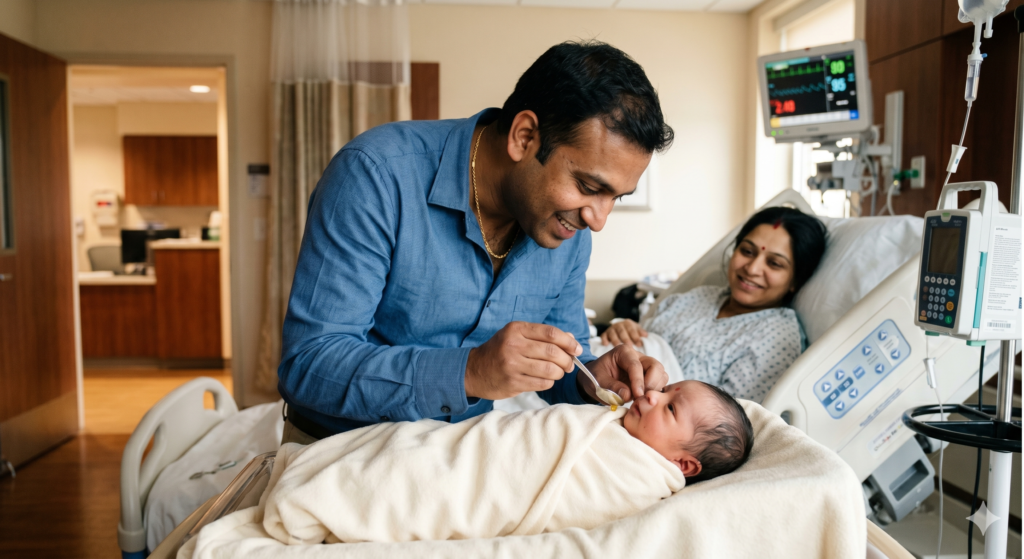
The most distinctive element of Jatakarma is the honey ghee first feed newborn jatakarma , the father’s act of placing a small amount of honey and ghee on his fingertip and gently touching it to the baby’s tongue.
This act is called Medha Janana, the birth of intelligence. The honey represents Vak , eloquence, the power of language and expression. The ghee represents Ojas , vital energy, the concentrated life force. Together, they are the first substances the baby tastes in this world, and the tradition holds that what the baby receives in that first moment of reception shapes their capacity for learning, speech, and vitality.
The father performs this act while reciting specific mantras from the Rig Veda , mantras that invoke Saraswati, the goddess of wisdom, and Brihaspati, the teacher of the gods. The intention is that the baby’s first conscious encounter with the world is an encounter mediated by sacred sound and divine invocation.
This is the foundational distinction of Jatakarma from any modern equivalent: it is the father who performs the first meaningful act with the newborn. Not the doctor, not the nurse, not even the mother in this specific moment. The father claims his role as the child’s first guide in the world.
The Second Act: The Ear, Sound Before the World
The second element of jatakarma sanskar meaning involves the father leaning close to the baby’s right ear and softly reciting a Vedic mantra , typically the Gayatri Mantra or a specific invocation to the Sun, the ultimate source of consciousness and illumination.
This act encodes the understanding that what a baby hears first sets the pattern of what their consciousness will be oriented toward. The right ear is chosen deliberately , in Vedic anatomy, the right side corresponds to the solar, active, conscious dimension of a person. The mantra planted in the right ear in the first moments of life is understood to be the first seed of spiritual awareness.
The Third Act: The Name , The Secret Whispered Name
In some traditions, a preliminary secret name is whispered to the baby at Jatakarma , a name chosen from the family’s ishta devata or from the parents’ most sincere aspiration for this child. This is distinct from the formal name given at Namkaran. It is an intimate, private gift from the father , the first personal communication between parent and child in this world.
Why Jatakarma Is Almost Never Performed Today
The honest reality is that most families who want to perform jatakarma after birth ceremony face a significant practical obstacle: it needs to happen in a hospital delivery room, often within minutes or hours of birth, and most hospitals in India are not set up to accommodate this.
But the shastras are practical. The Paraskara Grihyasutra explicitly states that if the ceremony cannot be performed at the ideal moment, it should be performed as soon as possible after the ideal moment has passed , and its power is not lost.
For home births, Jatakarma is straightforward to perform. For hospital births, the practical approach is:
- The father can perform the honey ghee first feed newborn jatakarma as soon as the baby is stable and the immediate medical care is complete , often within the first hour
- The mantra in the right ear can be whispered at any point when the father first holds the baby
Jatakarma and Its Relationship to Namkaran
Many families are surprised to learn that Jatakarma and Namkaran are separate ceremonies , because they have only ever performed Namkaran. The relationship between them is sequential and complementary.
Jatakarma is the immediate act of welcoming and establishing the child’s spiritual identity in the world. The first ceremony after baby born Hindu marks the soul’s arrival and claims it with sacred intention.
Read More about Namkaran Sanskar
Namkaran, performed on the eleventh or twelfth day, gives the child their formal name and nakshatra identity. It is the public ceremony of naming.
Jatakarma is the private, intimate, immediate ceremony of first encounter. Together, they form the complete birth-stage ritual sequence.
With our Namkaran ritual kits, you can now perform the ceremony from the comfort of your own home with complete peace of mind. Our carefully prepared kits ensure that every mantra, offering, and step of the ritual follows Vedic tradition, so you can focus fully on devotion and your child’s sacred beginning.
With clear guidance and authentic samagri, families can perform the baby’s naming ceremony on their own, knowing it is done with purity, care, and spiritual correctness.
Why families trust our Namkaran kits
- Essential mantras included with clear guidance for correct chanting
- Complete, pre-arranged samagri prepared as per Shastra
- Simple, step-by-step flow that allows you to perform the ritual at home
- Support available to help you select the right kit and perform the ritual correctly
Buy your Namkaran Puja Kit today – 8104030300
Vandan Pandit – Trusted Panditji Services for Every Sacred Beginning