The 16 Sanskaras of Life: A Complete Guide to the Hindu Sacred Rites
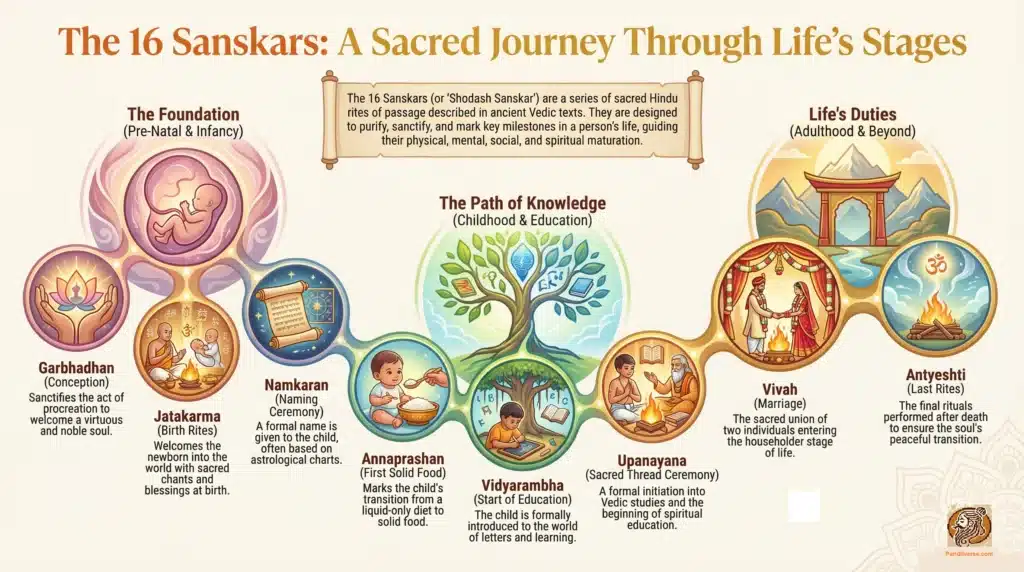
Every religion has its rituals. But no tradition in the world has mapped the entire arc of a human life , from before conception to the moment of death , with the systematic, loving precision of the Vedic Shodash Sanskar. These are the sixteen rites of passage, prescribed by the ancient shastras, that sanctify each threshold of human existence and ensure that no significant moment in life passes without intention, grace, and divine witness.
Understanding the 16 Hindu rites of passage is not a matter of academic interest. It is an invitation to recognise that every stage of your life , and the life of every child you bring into the world , has been honoured by the tradition for thousands of years.
What Are the Shodash Sanskar?
Shodash Sanskar meaning comes from two Sanskrit words: Shodash meaning sixteen and Sanskar meaning impression, purification, or rite. The Shodash Sanskar are the sixteen sacred ceremonies that, together, constitute a complete Vedic life.
The Manusmriti, the Gautama Dharmasutra, and the Yajnavalkya Smriti all enumerate these sixteen. The Shodash Sanskar meaning list describes them as the instruments through which a human being is progressively refined , from birth to death , like gold purified through fire. Each ceremony is a moment of divine attention, a moment when the family consciously aligns the individual with the cosmic order.
Ream more about Birth Sanskars in Modern Families
The 16 Sanskaras in Hinduism: Complete With Meaning
1. Garbhadhana , Conception
The first of the 16 Sanskaras in Hinduism is performed at the time of conception. It is the ritual through which the couple invites a spiritually evolved soul into their family. The ceremony involves specific mantras addressed to the couple’s ishta devata and a sacred intention set by both parents before the possibility of conception. It acknowledges that the choice to bring a life into the world is a spiritual act, not merely a biological one.
2. Punsavan , The Fetal Ceremony in the Second or Third Month
Punsavan is performed in the second or third month of pregnancy and is one of the three prenatal Garbh Sanskars. The ceremony invokes divine blessings for the physical and spiritual health of the developing fetus. The Atharva Veda contains specific hymns for Punswan that address the baby’s nervous system and constitution.
Read more about Punsavan Sanskar
3. Seemantonayan , The Third Month Onward, Up to the Seventh Month
The third Samskara of the 16 Hindu rites of passage is Seemantonayan , the hair-parting ceremony performed in the sixth or seventh month of pregnancy. It is addressed primarily to the developing mind of the fetus and to the emotional wellbeing of the mother. The husband’s formal role in this ceremony makes it unique among the prenatal Sanskaras.
Read more about Seemantonayan Sanskar
4. Jatakarma, Immediately After Birth
The first ceremony performed after the baby is born. The father touches honey and ghee to the baby’s tongue while reciting mantras of intelligence and eloquence. He whispers a mantra into the baby’s right ear. This is the formal welcome of the new soul into the family and the world.
Read more about Jatakarma Sanskar
5. Naamkaran, The Naming Ceremony (Day 12 or 13)
Perhaps the most widely known of the 16 Sanskaras in Hinduism. The baby receives their formal name , chosen based on their birth nakshatra , on the eleventh or twelfth day after birth. The name is whispered in the baby’s right ear by the father before being announced to the family. The Naamkaran is the child’s formal entrance into their social and cosmic identity.
Read more about Namkaran Sanskar
6. Nishkramana, First Outing (Fourth Month)
The first time the baby is taken outside the home, in the third or fourth month after birth. The family visits a temple or a sacred space, formally introducing the child to the world beyond the domestic sphere. The ceremony includes specific prayers for the child’s safe navigation of the outer world.
7. Annaprashan, First Solid Food (Month 6)
The ceremony of the baby’s first taste of solid food. For boys, performed in an even month (sixth, eighth); for girls, in an odd month (fifth, seventh). The first food is kheer , rice cooked in milk and sweetened , offered by the grandmother in a silver vessel while mantras are chanted to the goddess Annapurna.
Read more about Annaprashan Sanskar
8. Chudakarma (Mundan), First Haircut (Year 1 to 3)
The shaving of the baby’s head , the hair with which they were born. This hair is considered to carry the karmic residue of the previous life. Its removal is a symbolic purification, a clearing of the past, and a physical renewal of the child at the threshold of conscious awareness. Performed between the first and third year.
9. Karnavedha, Ear Piercing
The piercing of the ears, traditionally performed for both boys and girls. In the Vedic tradition, the ear’s specific anatomical points correspond to acupressure meridians governing the health of the eyes and reproductive system. The ceremony is accompanied by specific Vedic mantras.
10. Vidyarambha, Beginning of Education
The formal introduction of the child to learning. The child’s hand is guided by an elder or teacher to trace the first letters in rice or sand while mantras to Saraswati are chanted. This ceremony marks the activation of the child’s intellectual life as a sacred endeavour.
11. Upanayana, Sacred Thread Ceremony (Ages 8 to 12)
Among the most significant of the Hindu life rituals 16 stages, the Upanayana marks the beginning of a young person’s formal relationship with the Vedic tradition. The sacred thread , the Yajnopavita , is invested on the student’s body, and they formally become a student of dharma. The Gayatri Mantra is imparted for the first time.
Read more about Upanayan Sanskar
12. Vedarambha, Beginning of Vedic Study
Following the Upanayana, the formal study of one of the four Vedas begins. This ceremony marks the initiation of the student into the Vedic learning lineage.
13. Samavartana, Completion of Education
The ceremony marking the end of formal Vedic education and the student’s return to householder life. It is a formal graduation from the Brahmacharya stage to readiness for Grihastha , the householder stage.
14. Vivah, Marriage
The marriage ceremony is the most elaborate of all the Shodash Sanskar , involving seven vows, sacred fire, specific planetary alignments, and a formal merging of the two families’ dharmic lineages. Marriage in the Vedic tradition is not primarily a social contract but a spiritual covenant.
Read more about vaidik vivaah sohala
15. Vanaprastha , Retirement and Withdrawal
The formal transition from active householder life to a stage of greater spiritual focus, typically as children are grown and grandchildren begin to arrive. The ceremony marks the conscious withdrawal from worldly ambition and the beginning of a life directed toward dharma and moksha.
16. Antyesti, The Last Rites
The final of the 16 Hindu rites of passage. The ceremonies surrounding death , the preparation of the body, the cremation, the post-death rituals (Sapindha Shraddha, Asthi Visarjan) , are understood as the final purification of the soul, preparing it for its journey beyond this life.
Why the Shodash Sanskar Matter for Modern Families
The question is sometimes asked: are these ceremonies necessary? The tradition’s answer is nuanced. They are not mandatory in the legal sense. But they are understood as the means by which a human life is consecrated , marked as intentional, sacred, and aligned with the cosmic order.
A life lived without any of the Shodash Sanskar is not diminished. But a life in which each threshold is met with conscious ceremony , with mantra, with fire, with intention , is a life in which nothing is left unconscious. The tradition holds that this is the meaning of dharma: not following rules, but living with awareness at every stage.
Begin the Shodash Sanskar Journey With Vandan Pandit
For the prenatal Garbh Sanskars , Punswan, Seemantonayan , and the birth-stage Sanskaras , Jatakarma, Naamkaran, and Annaprashan , Vandan Pandit performs each ceremony according to the full Vedic vidhi at your home in Pune, Mumbai, and Maharashtra.
Every ceremony includes muhurat consultation, all samagri, and the complete ritual sequence as prescribed in the Grihyasutras.
Why choose Vandan Pandit?
With Vandan Pandit, you receive:
- Muhurat selected according to the Panchang
- Pure and authentic rituals performed as per Vedic scriptures
- Complete arrangement of all required puja materials
- Clear guidance explaining the meaning and significance of each ritual
Our Strength
- A network of 1500+ trained and certified pandits across Maharashtra
- Complete puja samagri arranged by our team
- A culturally refined, respectful, and stress-free puja experience
Book your puja today: 8104030300
Serving across Maharashtra | 1500+ Vedic pandits